Create Digital Music — DJ and Music Tech — Mon, 24 Aug 2026 16:27:40 +0000
Summary
Jakub Charkiewicz of theaudiostuff.com has created a free website for conducting ABX audio tests, inspired by earlier CDM articles advocating blind testing for claims about audio quality such as Tidal hi-fi streaming and Apple Music lossless. The site offers six pre-built test pairs—including 24-bit versus 8-bit decay and a 0.5dB level mismatch—and also lets users upload two of their own files, reporting results with a p-value so that 12 correct answers out of 16 yields a statistical verdict. Charkiewicz says two findings stood out: most listeners misinterpret a 0.5dB volume difference as clearer highs or a wider soundstage rather than pure loudness, and most cannot reliably distinguish 24-bit from 16-bit audio on full mixes except during extreme reverb decay or quiet passages near the noise floor. He has used the tool to check streaming codec claims and to test whether high-sample-rate DAW exports make an audible difference on final masters. The article also mentions a similar site, abxtest.com, which offers pre-loaded music for ABX comparisons.
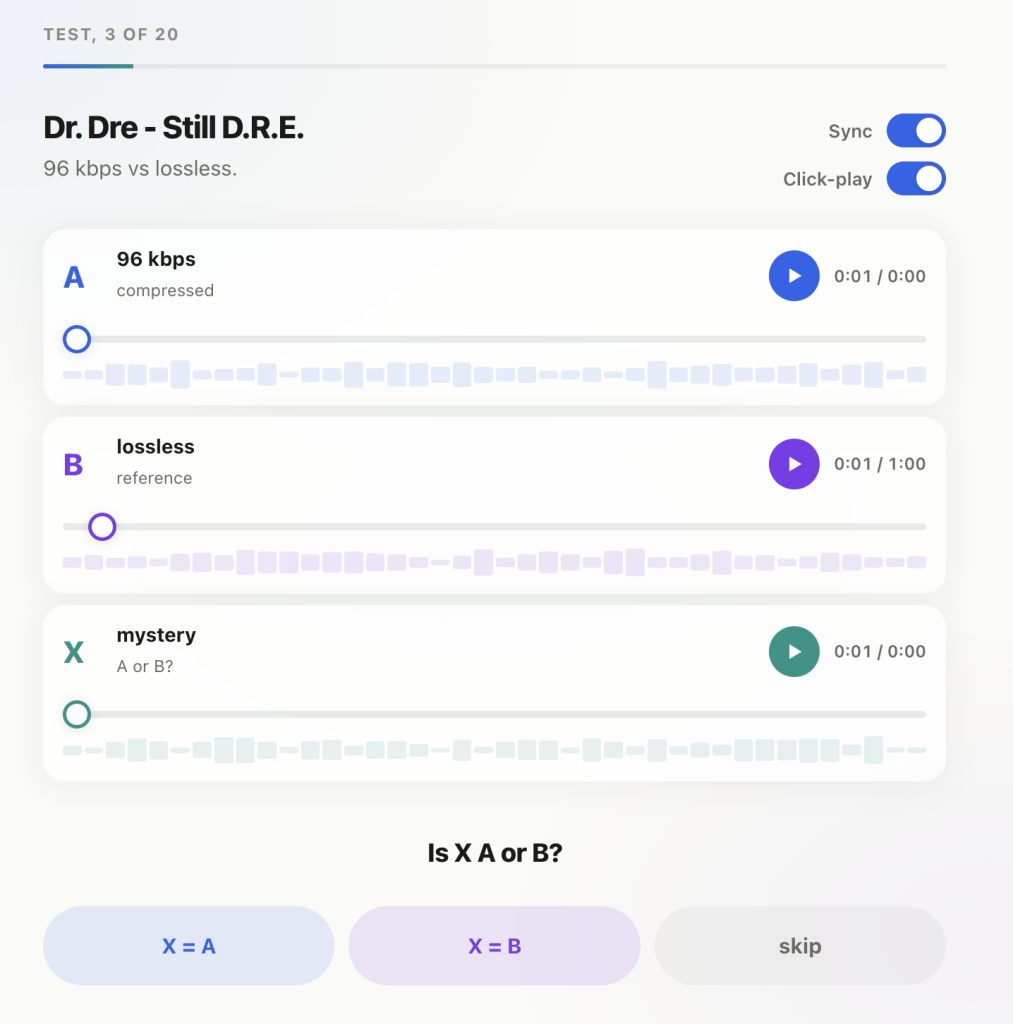
Can you really tell the difference between encoding methods? Two different kick drum emulations? 16-bit versus 24-bit? These aren’t subjective questions: you can actually test them–with science. (Science!) Here’s a site that lets you create your own ABX tests, or try some pre-built ones. Argue about other stuff instead!
The idea is simple. Listen to A. Listen to B. Is X … A, or B? Or which is higher, louder, whatever. Jakub Charkiewicz of theaudiostuff.com writes CDM to put us all to the test:
Two of your posts land on the same question. The 2015 Tidal hi-fi piece tells readers to run their own blind test, and the 2021 Apple Music lossless post says a double blind test can settle the bit depth argument. The blind test that older post points to does not load anymore.
So I built one on my site. Six built in pairs, including 24 bit versus 8 bit decay and a 0.5dB level mismatch, or drag in two of your own files. It reports a p-value, so 12 right out of 16 gets a verdict instead of a shrug.
Well, it’s good the Internet remembered what I wrote, as I didn’t! But indeed, you can give it a try. Jakub has some great, pre-built tests to explore, plus more tests on topics like EQ. And you can make your own. Plus, you can try this out on some friends, as well.
I was curious if Jakub was surprised by any results. He tells us:
Two main things stood out:
The 0.5dB volume trap where almost everyone misinterprets a tiny .5dB level difference as clearer highs or a wider soundstage rather than pure loudness. It really proves how easily human bias distorts listening tests without strict gain matching.
Bit-depths are something most listeners can’t reliably pick out – 24-bit vs 16-bit on full musical mixes. It only becomes distinct during extreme reverb decay or quiet synth tails down at the noise floor – which is why I included the decay pair in the tool.
Applied-wise, I’ve been using it to sanity check streaming codec claims (like Tidal/Apple Lossless) and test whether high-sample-rate DAW exports actually make an audible difference on final masters vs pure placebo.
That’s a terrific idea, and like Jakub, I’m also interested in whether y’all have other stuff you’d like to see in comparison testing. Let us know in comments.
For some pre-loaded music, I randomly came across this abxtest.com site, too, which runs on the same principle. I’m linking mainly because I laughed out loud at the “prove it. or shut up about flac.” heading.
Original article: https://cdm.link/free-abx-testing/ Source: Create Digital Music